
This chart is not copyrighted and may be downloaded or printed.
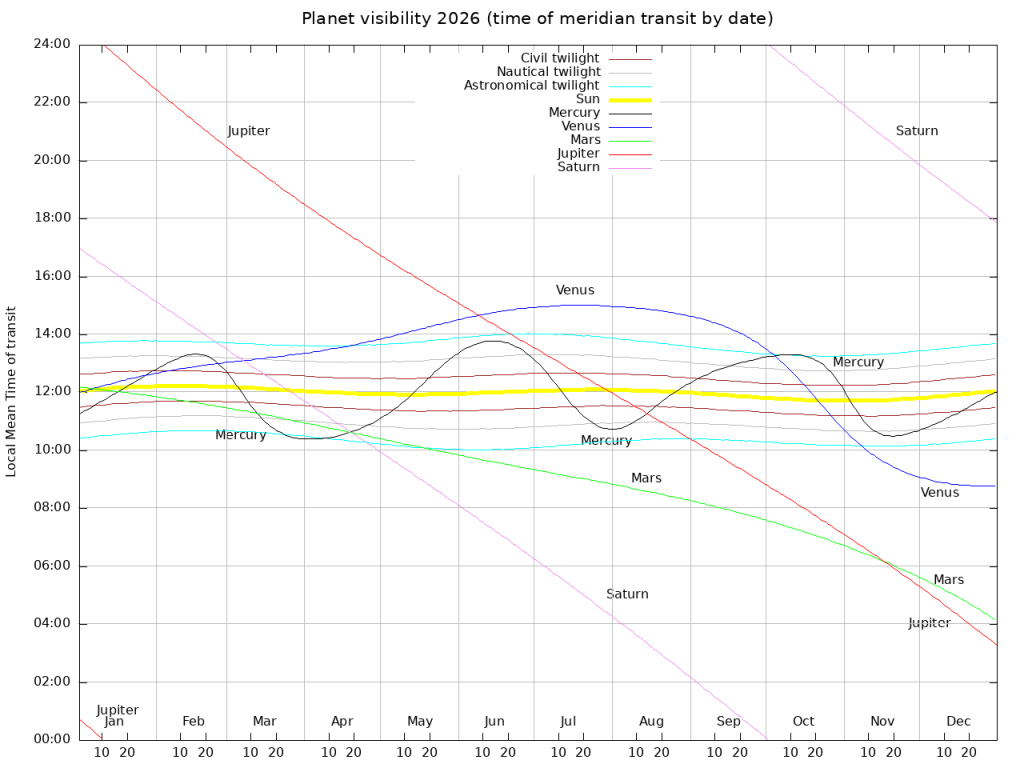
Understanding the Planet Visibility Chart
The planets are constantly changing their positions in our sky as Earth and the other planets travel around the Sun. This chart provides a way to visualize those changes over an entire year, showing not only when planets are visible but also how their positions change relative to one another.
The horizontal axis represents the date, and the vertical axis shows the time of meridian transit — the time when an object crosses the imaginary north-south line through the sky and reaches its highest point above the horizon. A planet transiting around midnight is generally well positioned for nighttime viewing. Planets transiting in the afternoon are in the daytime sky, while those transiting in the early morning hours are best observed before sunrise. Thus, the upper portion of the chart generally represents the evening sky, and the bottom represents the morning sky. The colored twilight lines help indicate the transition between daylight and darkness.
One particularly interesting feature is where the planetary lines cross. These crossings indicate conjunctions, when two planets have approximately the same position in the east-west direction in our sky. They may appear close together, although their actual angular separation also depends on how far north or south each planet lies. A crossing between a planet’s line and the Sun’s line similarly indicates a solar conjunction, when the planet is generally difficult or impossible to observe because of the Sun’s glare.
Notice that some lines slope steadily downward, while others curve or change direction. These patterns reflect the combined orbital motions of Earth and the planets. The chart therefore tells two stories at once: when to look for planets in the night sky, and how the geometry of our solar system changes throughout the year. Following the lines from January through December is a way of watching celestial mechanics unfold.
Importance of the twilight lines
Technically speaking twilight is divided into three periods: Civil Twilight, Nautical Twilight and Astronomical Twilight.
Civil Twilight is the time where the Sun has set, but it is still light enough outside to (for example) play softball.
Nautical Twilight is a bit of an old fashioned term in these days of GPS. It represents the time when the horizon is still visible, and yet important navigational stars are also. This was important when mariners and surveyors used stars for determining location. Many bright stars as well as Venus and Jupiter are clearly visible during Nautical Twilight.
Astronomical Twilight is where there is still some light, it is not yet totally black, but there may be enough light to obscure faint stars.
Important case in point: On or about the 12th of October, Mercury is at the edge of the Astronomical Twilight time, and therefore will be optimally visible.